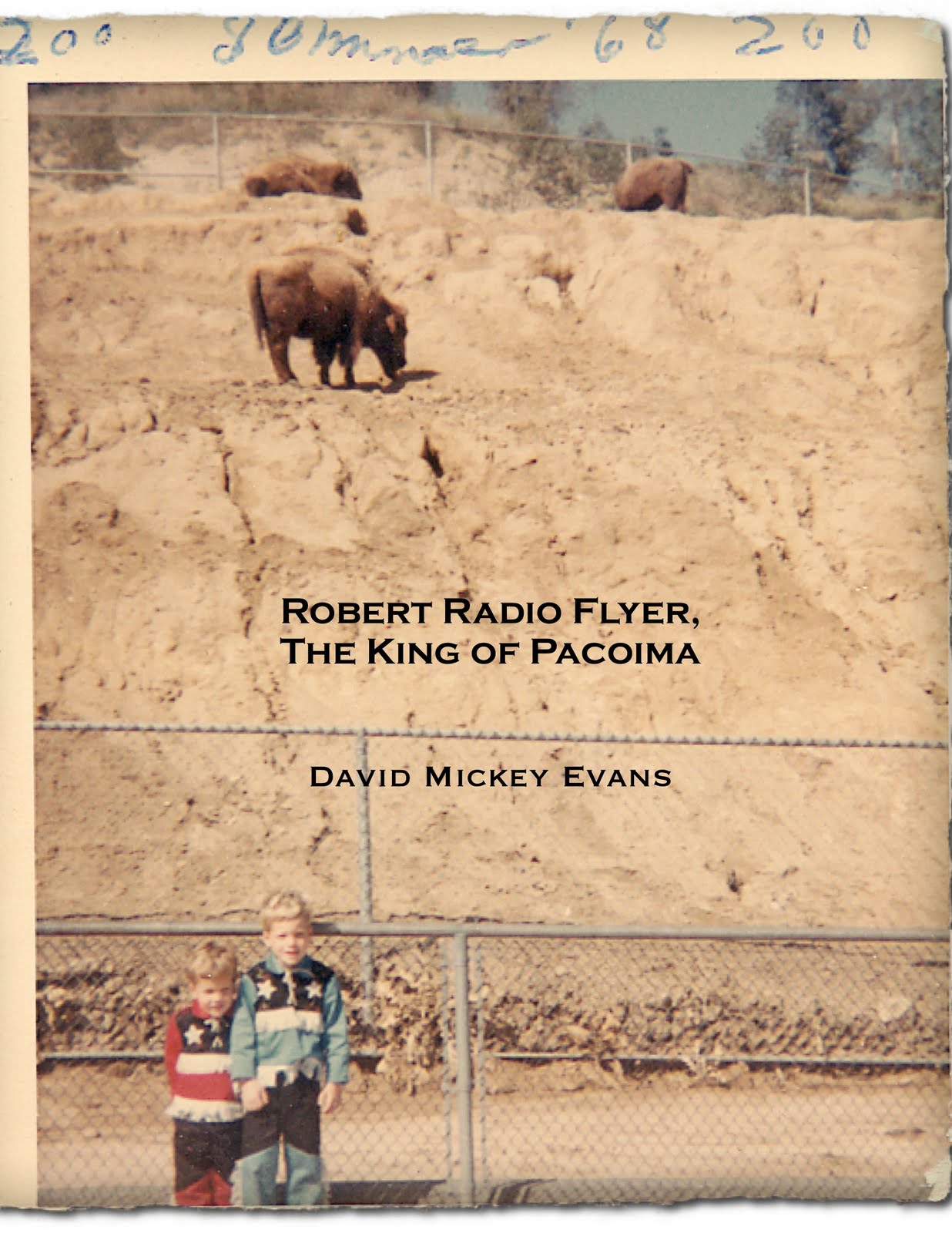
Here's the preliminary cover art of my new book, Robert Radio Flyer, The King of Pacoima. If I can figure out how to post a pdf chapter in Blogspot I'll do so this week.
Here's a link to a web show mentioning a very big film I am attached to direct, Glastonbury, Isle of Light, which tells the story of Joseph of Aramithea. It's about two minutes in.
I'm going to move soon. So I have been boxing up my library while simultaneously entering all my volumes into a couple great database programs; Delicious Library for Mac and Collectorz Library. Collectorz is a far deeper program while Delicious is easier - scan the bar code through your MacBook camera and boom. Done. This helps when you have 4,000 odd volumes. Collectorz does the same thing but you have to buy the extra barcode scanner. No thanks. The nice thing is you can enter everything into Delicious and then import it to Collectorz. Simple. Cheaper. Better.
Inevitably I re-discovered and started reading stuff I had forgot I had, like "The Leather Bound Library of The Complete Works of Ernest Hemingway." I love Easton Press books, leather bound, heavy, beautiful bindery, acid free nuke-proof paper and sometimes some really interesting forwards and introductions commissioned exclusively for the individual volumes themselves. Easton Press books are wonderful, they feel solid, they look beautiful and you can actually use them as blocks with which you can build a hurricane proof shelter in the event you need one.
So, Papa. The Old Man. The Goddamn Old Bullfighter...
Easton Press Editions of Hemingway
The five volumes I recently tore through are In Our Time - 1925, The Green Hills of Africa -1935, To Have and Have Not - 1937, The Dangerous Summer - 1960, and The Garden of Eden - posthumously 1986.
in our time: (it was originally published without capitals) is a complexly interwoven series of snapshot short stories the chapters of which (each of which is a short story in itself) are bridged with the most evocative and see-it-all by saying-next-to-nothing paragraphs you'll ever read. It includes three of my favorite short stories of all time, Indian Camp, Big Two-Hearted River: Part I, Big Two-Hearted River: Part II.
Here's the bridge paragraph from CHAPTER VII: "They shot the six cabinet ministers at half-past six in the morning against the all of the hospital. There were pools of water in the courtyard. There were wet dead leaves on the paving of the courtyard. It rained hard. All the shutters of the hospital were nailed shut. One of the ministers was sick with typhoid. Two soldiers carried him downstairs and out into the rain. They tried to hold him against the wall but he sat down in a puddle of water. The other five stood very quietly against the wall. Finally the officer told the soldiers it was no good trying to make him stand up. When they fired the first volley he was sitting down in the water with his head on his knees."
That is writing cleanly where the density is all below the surface - a good example of what Hemingway referred to as the Iceberg Theory of writing (this from Wikipedia):
In his writing the facts float above water; the supporting structure and symbolism operate out-of-sight.Writing in "The Art of the Short Story," he explains: "A few things I have found to be true. If you leave out important things or events that you know about, the story is strengthened. If you leave or skip something because you do not know it, the story will be worthless. The test of any story is how very good the stuff that you, not your editors, omit."
The Green Hills of Africa: Hemingway goes to Africa. On safari. With a big gun. Hemingway shoots every living thing with four legs and two horns. And likes it. Okay so that's what it is on the surface, but beneath all the Kudu tracking, Rhino shooting, Lion hunting it's really about Hemingway examining writing and his life and what it all means. The introduction in this volume is by Patrick Hemingway, one of Hemingway's sons. I did not like it. I do however very much like the forward Hemingway included:
"Unlike many novels, none of the characters or incidents in this book are imaginary. Any one not finding sufficient love interest is at liberty, while reading it, to insert whatever love interest he or she have at the time. The writer has attempted to write an absolutely true book to see whether the shape of a country and the pattern of a month's action can, if truly presented, compete with a work of imagination."
A couple of my favorite excerpts:
"All modern American literature comes from one book by Mark Twain called Huckleberry Finn. If you read it you must stop where the Nigger Jim is stolen from the boys. That is the real end. The rest is just cheating. But it's the best book we've had. All American writing comes from that. There was nothing before. There has been nothing as good since."
"Because there are too many factors. First, there must be talent, much talent. Talent such as Kipling had. Then there must be discipline. The discipline of Flaubert. Then there must be the conception of what it can be and an absolute conscience as unchanging as the standard meter in Paris, to prevent faking. then the writer must be intelligent and disinterested and above all he must survive. Try to get all these in one person and have him come through all the influences that press on a writer. the hardest thing, because time is so short, is for him to survive and get his work done. But I would like us to have such a writer and to read what he would write."
To Have and Have Not: All about Cuba, Key West, human trafficking, booze, revolution, murder and struggling to make ends meet. All the famous "Harry's Bars" in the world are named after Hemingway's main character Harry is this book. Some of the most crisp and clean dialogue you will ever read.
The Dangerous Summer: Hemingway goes back to Spain after many years to spend the summer traveling with two of the greatest bull fighters that ever lived. The introduction for the volume was written by James Michener, who states that Hemingway was so enraptured by returning to the subject, that he originally turned in a manuscript that was so long more than half of it was cut for the final book, which is hysterical because, get this, Michener's introduction to a book that runs 206 pages is 50 PAGES LONG! HA!
Michener was originally contacted in a bunker in Korea during the Korean War by a secret Life Magazine correspondent carrying a single (and only, so he represented) copy of a manuscript by Hemingway that Life intended to publish, but because of the disastrous reviews of Hemingway's previous novel, wanted some sort of praise worthy review in order to hedge their big gamble. Michener obliged. That copy of Life magazine sold 5,318,650 copies. An absolute impossibility in those days. What was the manuscript? The Old Man and The Sea. Pulitzer Prize. Nobel Prize.
After the success of all that, Life once more asked Hemingway to write them something and conceived the idea of sending him back to Spain (his favorite country) for a series of articles on bullfighting. that's where the book comes from. I liked it very much, but even although it's a bit of a "travel writing book" don't expect to find Paul Theroux in the pages anywhere - Hemingway is as much like Theroux as Theroux is like Stephen King. BTW, Theroux abhors Hemingway.
That's okay, Paul, I still love your books. ;)
The Garden of Eden
: Hemingway's examination of love, obsession, sexual loyalty or not, gender roles, and insanity. There's a very good introduction by John Updike. The book was begun in 1946 and left incomplete and published by Scribner's in 1986. From the introduction:
"It is possibly a pity that Hemingway's own inhibitions, if not those of the changing postwar times, prevented him from telling us exactly what the "devil things" are that lead David to call his wife "Devil," and poison their Eden even before Catherine decides, in her rampage of wanting, to introduce another, bisexual woman, Marita, into their honeymoon household."
Updike misses the point, either that or he's hellbent sucked in by the "Iceberg Theory" here, and doesn't realize it. The 7/8ths of the material that boils below the surface is exactly what makes the obsessive love scenes so explicitly powerful, if not downright lurid. Trust me, read it, and you'll know every single thing Catherine leads David into, not always willingly, in squirming detail without the author ever having described a single act. Masterful.
A few parting thoughts:
Hemingway on writing (purloined again from Wikipedia):
"Writing, at its best, is a lonely life. Organizations for writers palliate the writer's loneliness but I doubt if they improve his writing. He grows in public stature as he sheds his loneliness and often his work deteriorates. For he does his work alone and if he is a good enough writer he must face eternity, or the lack of it, each day."
Henry Louis Gates believes Hemingway's style was fundamentally shaped "in reaction to [his] experience of world war". After World War I, he and other modernists "lost faith in the central institutions of Western civilization," by reacting against the "elaborate style" of 19th century writers; and by creating a style "in which meaning is established through dialogue, through action, and silences—a fiction in which nothing crucial—or at least very little—is stated explicitly."
If a writer of prose knows enough of what he is writing about he may omit things that he knows and the reader, if the writer is writing truly enough, will have a feeling of those things as strongly as though the writer had stated them. The dignity of movement of an ice-berg is due to only one-eighth of it being above water. A writer who omits things because he does not know them only makes hollow places in his writing.
And my favorite thought in counterpoint to anti-Hemingway-ers (again, from Wikipedia):
Hemingway's intent was not to eliminate emotion, but to portray it more scientifically. Hemingway thought it would be easy, and pointless, to describe emotions; he sculpted collages of images in order to grasp "the real thing, the sequence of motion and fact which made the emotion and which would be as valid in a year or in ten years or, with luck and if you stated it purely enough, always." Although he wandered as he wrote, starting and then continuing and completing books in three, four or five five different locations, here's a picture Hemingway's writing desk from the Key West house. One day I will steal this desk and then I'll be a real writer.
Hemingway's writing desk
Thanks for reading and check back soon. If you haven't signed up to follow, please do.
These illustrations represent the evolution of my new on-screen production credit animatic logo for my company DAVID EVANS PICTURES. It ends with the rough draft of the animatic with music. I'm going to change the music but would love to know what you think of the spot.
Post a comment and let me know.
My next post is going to be a comparison of Hemingway's THE GARDEN OF EDEN,
TO HAVE AND HAVE NOT and,
THE DANGEROUS SUMMER.
Fascinating stuff from a fascinating writer who lived a fascinating life. Check back soon.
This is a mini-post. I'll have a longer more relevant post later today, but I thought I'd share this. It's worth 3 minutes of your time. Simply, I think, the best Time Lapse photography I have ever seen.
So a dozen years after the original The Sandlot I get a call from the head of Fox Home Video. He wants to make a sequel to The Sandlot. "Let's talk" he says. So I go and see him and we talk. He's enthusiastic, loves the original (his daughters' favorite film!) and has full confidence that after all these years a Direct-To-DVD sequel will sell big because of the success of the original. Almost every single one of these Head's of Home Entertainment at the studios, no, not almost, every single one of them has the same corporate-think about this; no original material, sequels only, and only sequels to successful material in their studio library. At this juncture this benefits me, so I have absolutely no problem with it. Mainly because...
... I had tried unsuccessfully for at least ten of those twelve years to interest them (Fox) in a sequel to no avail. Yet, The Sandlot kept selling. I try again. The answer is no. The Sandlot keeps selling. And I keep on trying because I have a plan. I have, I tell them, six additional iterations of The Sandlot story; the first one having taken place in 1962, the second I intend to take place in 1972, then 1982, 1992, 2002, 2012. Each story to take place on the same Sandlot a decade apart, with a new group of kids each time.
Make sense? I think it did.
So I bring this up to the Execs. The "Film" Execs. The answer is no. Want to know why? I was told, "Baseball movies don't play outside of the United States." Now, that may or may not be true. But the point is, what sort of answer is that? It's no answer. It's a "Keep my job by saying no" statement. But that sort of thinking is a subject for another column.
Anyway, so I have this meeting with Fox's Head of Home Video and it goes well. He says, at the end of the meeting, "Okay, Dave, go write it."
So I say, "Okay. No worries, just promise me one very important thing."
And he responds, "Sure. What?"
I say, "Don't send me to British Columbia. Don't send me to Canada to make this picture."
And I ask this because I had already shot three Direct-To-DVD films in Vancouver, BC, Canada all because of the exchange rate and tax incentives, $1.87 to $1.00 at the time. Do the math. At that point you couldn't really argue with that financial thinking.
And he laughs and says, "Of course not! My God, how could I send you to BC, Canada, to make a sequel to a picture that in the original was supposed to have taken place in The San Fernando Valley, California in 1962?!"
And I am mightily relieved. One, because I won't have to go to BC to shoot the film, and two, because, apparently, this exec is different than the rest, and "gets it."
But there's a hiccup. The studio wants me to write and direct the picture myself. They don't wish to employ the original co-writer (he hadn't gone on to write anything in the intervening years). They leave it to me to make that phone call. Ugh. It was awful.
The original contract was by this time expired and even though I had no legal (or as far as I was concerned moral) obligation to pay him anything, I did. Half the writing fee. For doing nothing. Why? Because that amount was far less than what it would've potentially cost to defend (and certainly win) a nuisance suit.
So, the script comes out great. I am very happy with it. And furthermore with having had to write both to budget (3.2 million - 1/3 the original budget of the original The Sandlot - it's direct-to-dvd, that's the game) and location (the San Fernando Valley as I have been promised by the Exec) I feel like since I designed the story and the production around those parameters, I can make a picture that if not meets the production level of the original, at least will be something that fulfills and perhaps exceeds expectations for a DVD sequel.
I submit the script. A few days later I get the call. Everyone loves it. Terrific, right? Yes it was. Here's a clip:
Then I get this phone call, "So, Dave, when can you leave for BC?"
Of course I knew this was gonna happen. And all the added problems of shooting a particularly American story in BC come crashing in, none the least of which is something that I just know that no one at Fox has thought about. Because of budgetary constraints I know what's coming next, and that is that they're going to tell me I have to cast most of the kids (there are nine of them in the story) out of BC. And Canadian kids don't sound anything like American kids. Specifically American kids in The San Fernando Valley, CA in 1972.
That's okay, that's why God created ADR, right? Maybe, but with the post-production budget and schedule I've been given there won't be much ADR time, and certainly no money to hire SAG kids in Los Angeles to re-voice entire characters in the movie later.
What to do?
So, I get up there, we cast the picture and I'm relatively satisfied with the group of kids I assemble.
Things go fairly well production design-wise, prop-wise, etc...
And then day one. I block the scene. My DP lights it. I say to the AD, "Bring in the talent." The kids arrive, three American kids and six Canadian kids. "Action," I say. And they act out the scene. And this is what I hear (I can't recall precisely, but it was something like this):
"Okay, come on, let's get oo-t of here."
Oo-t. Not "out." As in aboo-t, rather than "about."
In that little word literally resides the conceit of the entire film. If an audience anywhere goes to see this movie (or buys and takes it home), hears my voice (the narrator of the original) narrating this sequel, and then hears a bunch of kids running around inside this film speaking "Canadian" it's over. They'll shut the television off or leave the theater because they'll know instantly the picture was shot in Canada because everybody in the world knows the only people in the world that pronounce "out" as "oo-t" are Canadians.
What to do?
I call all the kids over, Americans and Canadians. I tell the American kids to look at the Canadian kids and say, "Out." They do. Then I ask the Canadian kids to repeat what they've heard. They all respond, "Oo-t." Ugh.
I line up the Canadian kids and try it one-on-one, "Repeat after me, out."
"Oo-t."
No, say it like I say it, "Out.
"Oo-t."
No, "Out."
"Oo-t."
I suddenly consider a career in a different field. Any field. Animal husbandry maybe.
"No, guys, ya gotta say it like an American. Otherwise everyone will see the wizard behind the curtain." They have no idea what that means.
"Okay, say, out."
"Oo-t."
Argh!!! What to do. Time is wasting. The hours child actors are allowed to work before the camera is severely restricted. Labor laws and all that. I'm already falling behind on the first day, not a good sign, and I'm running the risk of having nine young actors turn into pumpkins before I get the whole days' scheduled page count filmed. And then, inspiration! Thank you, Lord.
"Alright, all of you guys come over here." They do. "Everyone hold your noses."
"What? Why?"
"Don't ask questions, just hold your noses." They all do. "Pinch them shut good." They all do. Now, everyone, all at the same time say, out."
It comes out nasally, right from Southern California circa 1972: "Owwwwt!"
Perfect.
For the rest of the shoot, you could see them walking around between takes, pinching their noses and saying, "Owwt. Owwt. Owwt." They were all great kids and wanted very much to get it all just right.
And for the record, The Sandlot 2 became the most successful Direct-To-DVD Family of all time.
So I'm standing on the infield of Kernel Stadium in Cedar Rapids Iowa in 2006, on location for my film THE FINAL SEASON. It has been brutal for the preceding two days; I was originally allocated 7 days in the original schedule to shoot a re-creation of the famous 1991 Iowa State High School Baseball Championship. The entire game mind you -- all 9 innings. I have the whole thing storyboarded (by my friend Ken Mitchroney), planned and ready to go, and at the last minute I'm cut down to three days. Budget issues to blame. I have literally hundreds of pre-planned camera set-ups (angles) to execute and there's no way I'll ever have time to get them all. I'm worrying. Hard. No, not worrying, just becoming more and more disappointed.
I have a chat with my DP Dan Stoloff, and we decide with an extra camera (bringing the total to four) and operator we might get 70% of them and with that material I might be able to edit together a semblance of what I originally had in mind. A solution, but disappointing.
So we get the camera and the operator, and we start. Right there, the first day, I rearrange all the elements in order to block shoot every particular section of the stadium in which there is scripted material. In other words assemble all the elements for all the material taking place in the stands, set up all four camera, and as they run, direct all the material in the script that happens there in the last 10 pages of the script, all at once, continuously, with the script pages in hand, directing through the stadiums PA system with a wireless mike, skipping over the interstitial material until I have it all. Then we breakdown the set-ups and move to the next section, the dugout. And so on.
It works well, notwithstanding that my actors are a little bewildered about "how" they are and "where" they are in the story. But there's no other way, there's no time.
Day one we finish with everything covered.
Day two we rack over 100 setups.
Then, on day three, my kids arrive to visit, including my then 8-year old daughter. On that day, through local radio stations and a grassroots sort of effort, the producers manage to get 1,200 or so extras to fill the stands. Mind you, there's 5,000 seats in the stadium, and 1,200 barely make a background at all, but at least I know I'll later be able to "CG tile" them into all the seats they don't physically occupy to make it look like the stadium is full (which it was in 1991) for the Championship game.
So, I let my daughter sit in my directing chair and she's very happy about that. And I can tell she's a little overwhelmed by all the production circus, and I can see that she keeps watching me interfacing with cast, crew, producers etc. spinning plates and going 10 directions at once. And I start to feel like she's a little bit in awe of her daddy because up till then I honestly don't think she had any idea what I do for a living. I mean she knows I'm a director and that I make movies, but exactly what that is I realize she hadn't any idea.
Day three goes right down to the wire, right down to the last second before there's simply not enough light to shoot anymore daytime footage and we get it all. I mean everything, every panel of every storyboard (except for one) and me, my DP, my AD and the producers are very happy. And all the people in the stands that were my free extras give us a standing ovation. Very very nice.
So I'm packing up my stuff, put my backpack on my shoulder, and say to my daughter, "You ready to go, sweetart? (not a typo, that's what I call her, my sweetart). And she says, "Yes." So I turn toward the stands to leave the field through the dugout tunnel and this is what I see:
About 1,000 of the extras, all lined up very quietly starting at the bottom of the stairs and stretching up into the loge level, down the hall and out into the parking lot. Waiting. For me. The other 200 or so were lined up on an adjacent set of stairs waiting for a particular actor for an autograph. He wasn't very happy about this. As I approach the line of people, I can see that most of them are holding The Sandlot DVD. My daughter has no idea that these people are waiting for me, and when I get close and the first DVD is put into my hand to sign, it suddenly occurs to her what's going on.
The actor signed a few autographs and left.
I stayed for over two hours and signed every autograph I was asked to, because it turns out that when the producer's advertised on the local radio the made it a point to say, "The director of The Sandlot..." and all these people were there to help with the true story about a home town team, AND shake my hand and tell me how much The Sandlot had meant to them. I choked up a couple of times. It was wonderful.
So, all this time, my daughter is standing there with me, helping me, handing me things and finally I sign the last autograph and shake the last hand and now it's dark and the stadium lights are on and it's pretty empty. We start walking away, my daughter and me, side by side toward the parking lot and she's very quiet. So I ask, "What's the matter sweetart?"
And she answers in a small voice, "Daddy, are you famous?"
And I say, "Well, just a little bit. Not too much."
And then, in a big voice she says, "WELL, THANKS FOR TELLING ME!"
We finished the rest of the walk to my truck holding hands and all my disappointment went away.
Here's the trailer:
Thanks for reading and check back soon. And sign up to follow on the right hand side of the page.